

Today’s stories open with SAVE. In case you missed it, it’s an immigration database the Supreme Court recently cleared for voter checks. Its history of flagging naturalized Americans as noncitizens should be highlighted, and in case you didn’t know, most Asian American eligible voters are naturalized. This is crucial because, at least in battleground Georgia, their turnout could decide the midterms.
Beyond the ballot, we’re looking at a couple of arrests. ICE held a Pennsylvania nurse for more than two weeks after she landed in Los Angeles for a Disneyland trip. The FBI also arrested an Irvine real estate agent who allegedly surveilled the U.S.-based son of Taiwan’s president. Meanwhile in Okinawa, U.S. commanders ordered a 48-hour lockdown after police arrested a Marine in the death of a 39-year-old Japanese woman.
We close the issue with the Grammys, which are keeping their new Asian pop category, and San Antonio Spurs guard Dylan Harper, who now has the Philippine flag’s sun and stars inked on his arm.
Featured
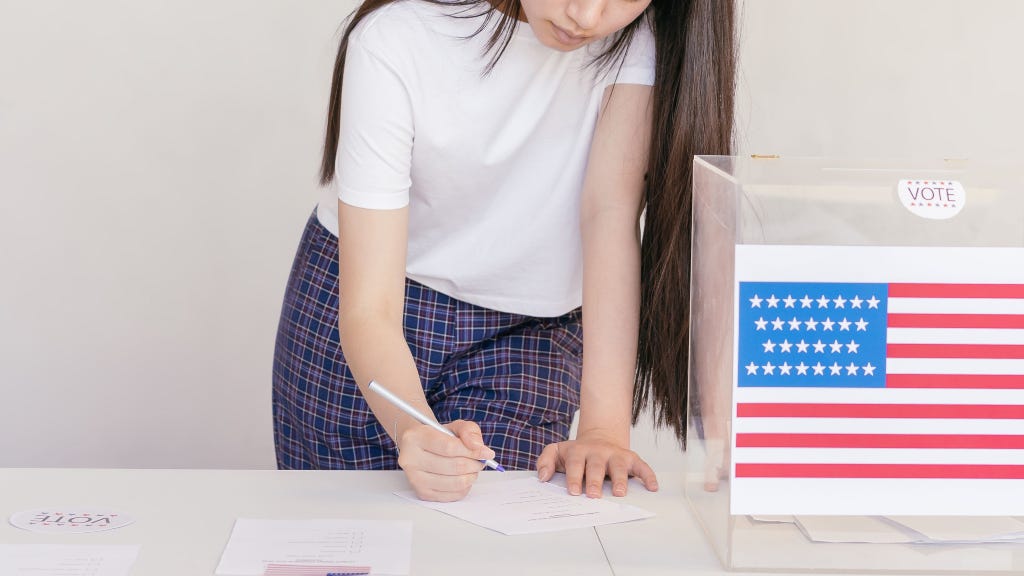
Asian Americans face a revived citizenship check with a record of errors
The Supreme Court voted 6-3 on Sept. 25 to pause a lower-court order barring the government from vetting voters through SAVE, a federal immigration database. The database has flagged naturalized citizens as noncitizens, and most eligible Asian American voters are naturalized.
Texas and Missouri offer an early look at its error rate. Certain names are reportedly more prone to matching errors, while states differ in how they handle flagged voters.
What else we’re tracking
Asian American turnout could decide Georgia’s midterms, lawmakers say
Illinois Sen. Tammy Duckworth called embracing one’s culture a “superpower” at a Friday event for Asian American and Pacific Islander community members in Georgia. Cincinnati Mayor Aftab Pureval reduced the turnout math to a single ratio.
A nurse’s family trip to Disneyland ended with 15 days in ICE detention
ICE detained Monica Ryadi after she landed in Los Angeles with her husband and 3-year-old son. In 2010, an immigration judge shielded the nurse from removal to Indonesia. The DHS now calls her an “illegal alien.”
Irvine real estate agent arrested at LAX over alleged surveillance of Taiwan’s president’s son
The case against Wanying “Heather” Zhang, a naturalized U.S. citizen, includes a message she allegedly sent a Chinese official. Taipei has responded, but more broadly, the arrest could revive suspicion of Chinese Americans.
A Japanese woman’s murder puts US troops in Okinawa on lockdown
Police arrested a 20-year-old Marine in Anna Yagi’s death, and he has denied the allegations. Okinawa Gov. Genta Koja said the prefecture has concluded that the U.S. military’s discipline measures and human-rights education have failed.
Grammys CEO: ‘Asian pop’ category is here to stay
The Recording Academy reconsidered its new award for best Asian pop music performance after online backlash and BTS’ withdrawal from 2027 Grammy consideration. CEO Harvey Mason Jr. said one side of the debate was louder.
Dylan Harper is wearing his Filipino roots on his sleeve
Ahead of his second NBA season, San Antonio Spurs guard Dylan Harper added a tattoo drawn from the Philippine flag. It follows other public tributes to his Filipino heritage, including one he wore during the playoffs.
Why read Issue #268?
To be specific, nearly two-thirds of eligible Asian American voters are naturalized citizens. But federal records do not always show it. Social Security files, for one, are not automatically updated after naturalization, and a flagged voter has to prove citizenship. Legal protection does not always prevent detention either, as a Pennsylvania nurse found out in Los Angeles.
As we can see, some people answer on their own terms. Dylan Harper wears his heritage on his arm, and BTS is sitting out the 2027 Grammys over a category that divides music by region or language. Voters get a say, too. In Georgia, AAPI voters are at least 3% of the electorate, and they could swing a race as close as 2020’s.
Read this issue with Nov. 3 in mind, because we’re getting closer.
Support independent Asian diaspora journalism. Become a paid subscriber to read the full stories and help sustain The Rebel Yellow.
The Rebel Yellow is supported in part by funding from The Asian American Foundation (TAAF). Funders do not influence story selection, reporting, or editorial decisions. All editorial content is independently produced by The Rebel Yellow team.