

The Rebel Yellow - Issue #188
Rep. Young Kim is heading into one of the most consequential Republican primaries of the cycle. California’s redrawn congressional map has forced the Korean American lawmaker into a rare incumbent-versus-incumbent contest with Rep. Ken Calvert, a race that could reshape Asian American representation within the GOP.
Elsewhere this week, President Donald Trump is facing criticism after attending a dignified transfer ceremony for six soldiers killed in a Kuwait drone strike while wearing a baseball cap, as the Filipino American community mourns Chief Warrant Officer 3 Robert Marzan. We also look at the shrinking expectations surrounding Trump’s upcoming summit with Xi Jinping, new uncertainty facing Philadelphia’s Chinatown Stitch project and how a viral Canadian snow video sparked anti-South Asian backlash online.
Plus: a former child YouTuber alleges abuse behind her once-viral channel, and Blackpink’s Jisoo and Seo In-guk talk AI dating in our latest interview.
California Rep. Young Kim headed toward brutal, high-stakes GOP primary
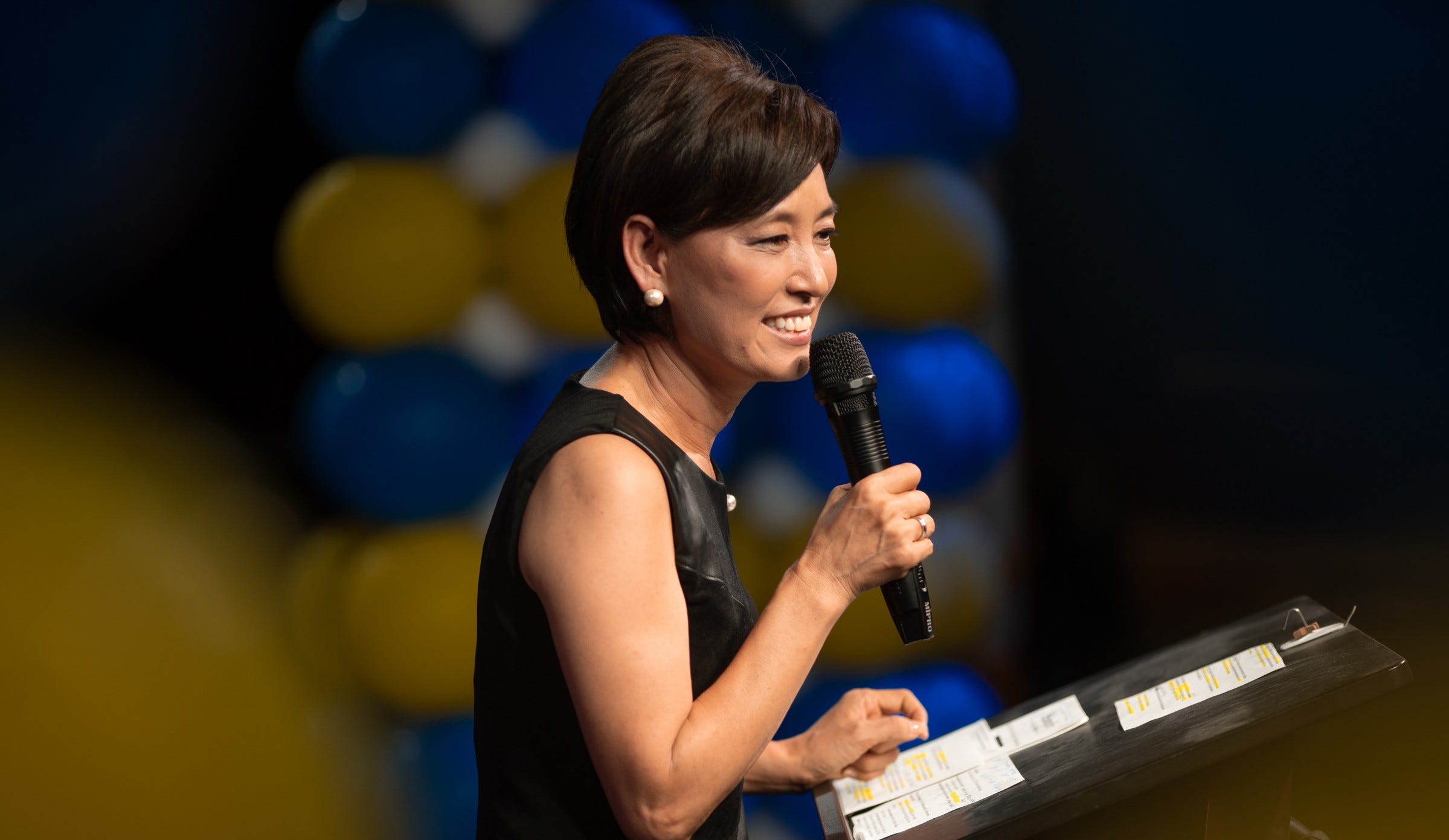
California’s redrawn congressional map has created one of the cycle’s most consequential Republican contests, with Rep. Young Kim facing another senior GOP member in a race where geographic loyalty, donor advantages and relationship with President Donald Trump could all prove decisive.
Head-to-head: Proposition 50, Gov. Gavin Newsom’s ballot measure targeting Republican gerrymandering in Texas, forced Kim and Rep. Ken Calvert into the new 40th District spanning Orange, Riverside and San Bernardino counties. Kim chairs the House Foreign Affairs Subcommittee on East Asia and the Pacific, while Calvert leads the House Appropriations defense subcommittee. A crowded Democratic field could send both Republicans to November, putting the National Republican Congressional Committee (NRCC) in a difficult position should the contest carry into a general election.
A race for representation?: The primary carries consequences well beyond one district. Kim, 63, is one of just two Asian American Republicans in the House, and her defeat would narrow an already thin margin of representation as the GOP looks to build on recent Asian American voter gains. As we previously reported, the majority of Asian Americans backed former Vice President Kamala Harris over Trump in 2024, though it was far closer than former President Joe Biden’s 70-30 advantage four years earlier.
“I am it,” Kim told the Washington Examiner. “Other than my colleague, [Rep.] Vince Fong from the Bakersfield area, we are the only two Asian American Republicans serving our entire Asian American community in this entire state of California.” She added, “I feel the weight on my shoulder to work as hard as I can to represent not just the Asian American voters, but the entire community.” Calvert, on the other hand, said he does not “worry about identity politics” and that voters want a “proven, consistent and effective conservative” regardless of race or gender.
The big picture: The Kim-Calvert race is one of several fault lines opened by Proposition 50, which drove some elected officials to forgo reelection and even abandon their party. Interestingly, both Kim and Calvert have staked out positions on issues important to Asian American communities. Kim voted to fund DHS operations amid AAPI advocates’ calls to withhold immigration enforcement funding, while Calvert backed Trump’s strikes on Iran under Operation Epic Fury, which drew sharp condemnation from AAPI lawmakers.
With California’s June primary approaching, all eyes are on whether Trump will break his avoidance of incumbent-versus-incumbent endorsements.
Trump criticized for wearing hat while honoring soldiers killed in Kuwait drone strike
President Donald Trump is facing criticism after attending the March 7 dignified transfer at Dover Air Force Base in Delaware honoring six U.S. service members killed in a drone attack in Kuwait, including Filipino American Army Reserve officer Chief Warrant Officer 3 Robert Marzan.
Footage from the ceremony shows Trump wearing a white baseball cap marked “USA” as flag-draped transfer cases were carried from a military aircraft.
Criticism over ceremony conduct: Images from the ceremony prompted criticism from commentators who said civilians typically remove hats during military honors ceremonies. On the ABC talk show “The View,” co-host Whoopi Goldberg criticized the moment, saying, “Take your damn hat off! I didn’t understand why nobody pulled his coattail and said, ‘Sir.’ Just out of respect!”
Media correction and White House response: Fox News Media later apologized after the network aired footage from a different dignified transfer that did not show Trump wearing a hat. “We inadvertently aired video from an older dignified transfer instead of the ceremony that took place yesterday,” correspondent Griff Jenkins said on “Fox & Friends Weekend.” White House Communications Director Steven Cheung defended the president in a statement, saying critics were “disgustingly playing partisan politics and they need their heads checked.”
Filipino American among six killed: The ceremony marked the return of the service members after an Iranian drone attack at Kuwait’s Shuaiba port killed six members of the U.S. Army Reserve’s 103rd Sustainment Command just hours after the war began. Marzan, 54, lived in Sacramento, California and served as a chief warrant officer in the Army Reserve. The Pentagon identified the other soldiers killed in the attack as Maj. Jeffrey R. O’Brien, Capt. Cody A. Khork, Sgt. 1st Class Nicole M. Amor, Sgt. 1st Class Noah L. Tietjens and Sgt. Declan J. Coady. All six were assigned to the 103rd Sustainment Command and were deployed to Kuwait in support of U.S. military operations in the region when the drone strike occurred.