

A shooting at the White House Correspondents’ Dinner put CBS News’ Weijia Jiang at the center of a moment she’s spent years covering from the outside. Her response drew attention not just for how she handled it, but for what it represented given her history in the briefing room.
Meanwhile, the Trump administration’s visa program touted as a major revenue driver has approved just one applicant, while backlash over rhetoric targeting Asian countries is drawing diplomatic and domestic concern. We also look at a federal raid now under criminal scrutiny, political appointments raising new questions and cultural debates unfolding across film and media.
Featured
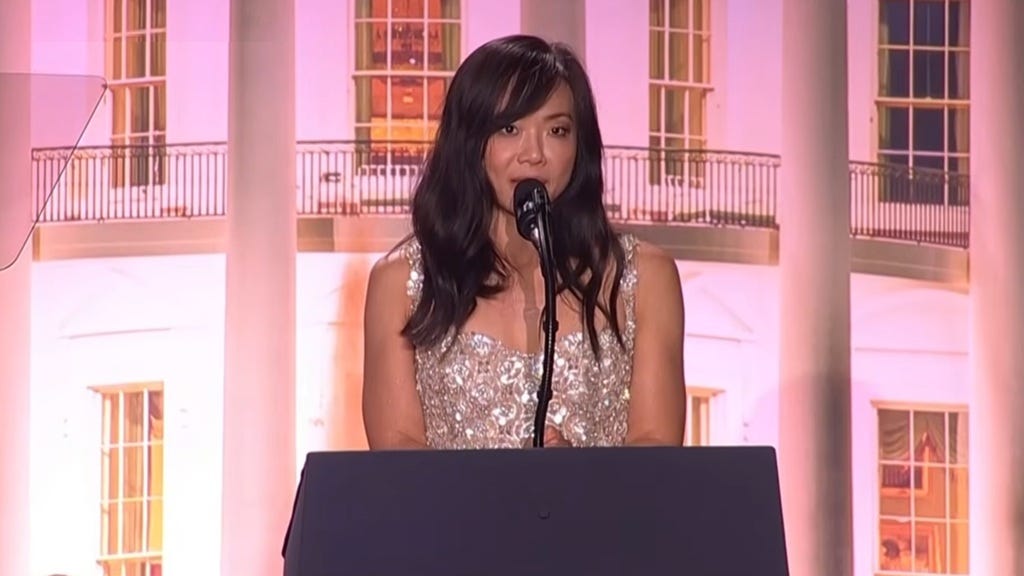
Weijia Jiang draws praise after WHCA shooting
CBS News journalist Weijia Jiang has drawn widespread praise after maintaining composure during a shooting at the White House Correspondents’ Dinner. A suspect armed with multiple weapons triggered panic inside the ballroom, sending attendees scrambling for cover as Secret Service agents responded.
Sitting right next to President Donald Trump, Jiang was ushered to safety before returning to help manage communications. Her response was noteworthy given her history of confronting hostility in the briefing room.
What else we’re tracking
Trump’s “gold card” visa approves just one applicant
A visa program touted by the Trump administration as a major revenue driver has approved just one applicant months after launch. The figure contrasts sharply with earlier claims of widespread interest, and questions are growing over how the program is actually being used.
Hung Cao’s past remarks resurface after promotion
A newly elevated Navy official is facing renewed scrutiny over past remarks involving controversial comparisons and rhetoric. His promotion places him in a key role during a sensitive moment.
China, India push back on Trump repost
China and India have both responded after Trump’s repost amplified remarks referring to their countries in derogatory terms. Officials call the language inappropriate and misleading, but the White House defends the president.
Rep. Grace Meng criticizes $1.5T Pentagon budget
Rep. Grace Meng is pushing back against a proposed $1.5 trillion Pentagon budget, arguing it comes at the expense of domestic programs. She cited cuts to healthcare and aid. The debate reflects shifting priorities.
Sydney Sweeney’s “Gundam” casting draws whitewashing concerns
Casting choices for a live-action “Gundam” film are raising concerns over representation. Critics say the decision shifts focus away from the franchise’s origins. The debate echoes past adaptations.
Study finds many Americans don’t reject undemocratic actions
Roughly half of Americans are open or neutral toward at least one undemocratic action, according to new research. The data suggests attitudes are more complex than simple support or opposition. The results could have broader implications.
Former roommate charged in deaths of Bangladeshi PhD students
A former roommate has been charged in the deaths of two Bangladeshi doctoral students in Florida. Investigators cited multiple forms of evidence in building the case. The incident has drawn international attention.
Ben Pasternak scandal deepens after Fred Liu statement
A second account has surfaced in the controversy involving Ben Pasternak, alleging physical violence during a previous relationship with Evelyn Ha. The Australian entrepreneur is fighting assault charges, while Ha maintains that boundaries were crossed.
Why read Issue #204?
Some of this issue’s stories unfold in the moment, where there’s no time to step back or process what’s happening. Others don’t fully register until later, once the immediate situation passes and the consequences start to take shape. A shooting, a policy decision or a public statement can feel contained at first, but the effects tend to spread quickly, often in ways that weren’t anticipated.
Support independent Asian diaspora journalism. Become a paid subscriber to read the full stories and help sustain The Rebel Yellow.
The Rebel Yellow is supported in part by funding from The Asian American Foundation (TAAF). Funders do not influence story selection, reporting, or editorial decisions. All editorial content is independently produced by The Rebel Yellow team.