

The Rebel Yellow - Issue #189
Estefany Rodríguez, a Colombian-born reporter for Nashville Noticias, was detained by federal agents just one day after covering ICE activity in the city, prompting press freedom groups to demand her release.
In this issue, we also look at a new poll showing public confidence in the U.S. Supreme Court has fallen to its lowest level in decades and the fallout from a stabbing that shook San Francisco’s Chinatown. Elsewhere, federal prosecutors are pursuing terrorism charges after explosives were thrown at protests outside New York City Mayor Zohran Mamdani’s home.
We’re also tracking the wider tensions shaping Asia and the diaspora, from the economic shockwaves of a potential Strait of Hormuz shutdown to the sudden pause in Chinese military flights near Taiwan. Plus: a new play examining ideological divides among Chinese American women in finance and a strike at a major Asian American civil rights organization.
Nashville journalist who covers ICE gets detained herself
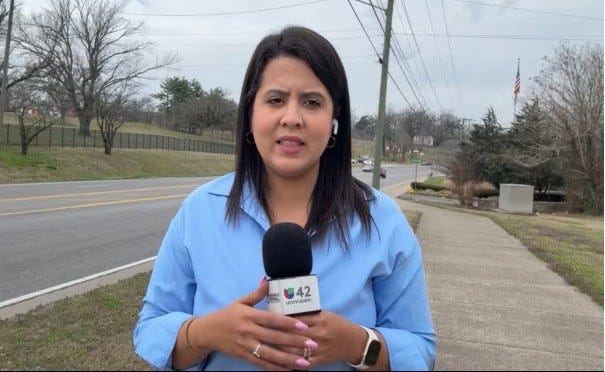
A Colombian-born journalist who covers immigration enforcement in Nashville now finds herself in Immigration and Customs Enforcement (ICE) custody, with her lawyers calling it an unconstitutional retaliation.
What happened: Estefany Rodríguez, a reporter for Spanish-language outlet Nashville Noticias, was arrested by ICE agents while traveling with her husband in the outlet’s branded vehicle on the morning of March 4. Agents from a Fugitive Operations Team had surveilled the family since early morning, waiting until the couple’s 7-year-old daughter had been dropped off. The detention came just one day after she covered ICE activity in the city.
ICE directed Rodríguez to report to its Nashville field office on Jan. 26, but a winter storm shut down the city that day. A second letter ordered her to appear on Feb. 25, but officials told her husband and attorney they could find no record of the appointment and rescheduled it for a later date. The government says a warrant was issued when she failed to appear, stating in court documents that “there was a valid warrant for her arrest as an alien issued on March 2, 2026, two days prior to her arrest.” Her lawyers, however, dispute this, arguing she was never served the warrant and that her detention violates her First and Fifth Amendment rights.
About Rodríguez: Rodríguez, 35, spent years in Colombia reporting on corruption and armed militia groups, drawing death threats that led to a government-assigned security detail. “When you report, you’ll find that some of these people don’t like what you’re reporting on, and they’ll get bothered and think they have to get rid of the reporter,” her father, Juan Rodriguez, told CNN in part.
Faced with no clear path to safety, Rodriguez fled with her daughter to the U.S. on a tourist visa in 2021, filing for asylum before it expired. She later married a U.S. citizen and applied for a green card. Her commitment to accountability reporting carried over to Nashville, where she covered immigration enforcement for Nashville Noticias and Univision 42 Nashville. She holds a work permit valid through 2029.
Why this matters: Rodríguez’s case resonates with Asian Americans who navigate similarly uncertain immigration frameworks with pending applications, mixed-status households and the reality that proper paperwork offers no guaranteed protection against enforcement. And for us at The Rebel Yellow who cover immigration, the immigration crisis and press freedom are not separate stories. The idea of a journalist being detained by the very agency she covers should alarm every community reporter holding those in power accountable.
A coalition of more than 40 press freedom organizations, including the Asian American Journalists Association (AAJA), have called for Rodriguez’s immediate release. “Rodriguez’s detention is part of a broader erosion of democratic norms and human rights in the
United States in which immigration authorities are increasingly being used to chill free expression and First Amendment rights. This practice must stop,” the coalition wrote.
Confidence in U.S. Supreme Court falls to historic low in new poll
Confidence in the U.S. Supreme Court has reached a historic low, according to an NBC News poll released this week. Just 22% of registered voters say they have strong confidence in the court, the lowest figure recorded since the survey began tracking the measure in 2000. The survey of 1,000 voters was conducted between Feb. 27 and March 3 and shows nearly four in 10 Americans now express little or no confidence in the court.
Historic drop in trust: Another 40% of respondents said they have only “some” confidence in the court, while 38% said they have very little or no confidence. Combined, 78% of voters report limited confidence or none in the institution.
NBC News polling shows that 52% of Americans said they had strong confidence in the Supreme Court when the survey first asked the question in December 2000, marking a decline of 30 percentage points over more than two decades. The previous low point in the survey came in 2022, when confidence dropped to 27% after the court overturned Roe v. Wade.
Sharp partisan confidence gap: Among Republicans, 35% said they have strong confidence in the Supreme Court, compared with 9% of Democrats, while independent voters reported levels between those groups. The poll also indicates confidence in the court has declined among both parties over time even as Republicans continue to report higher levels of trust than Democrats.
Jeff Horwitt, a Democratic pollster with Hart Research Associates who helped conduct the survey, told NBC News the results suggest the court is losing public confidence beyond routine disagreement over rulings. “It’s one thing to make controversial rulings that one party may or may not like but maintain respect and confidence,” Horwitt said.
Current state of the SC: The Supreme Court, which holds a 6-3 conservative majority following three appointments made during Donald Trump’s first term as president, has recently taken up several high-profile immigration disputes that have drawn national scrutiny. The justices agreed to review the legality of Trump’s effort to end birthright citizenship, a case challenging whether children born in the U.S. to parents without legal status are entitled to automatic citizenship under the 14th Amendment.
The court also allowed Immigration and Customs Enforcement agents to resume certain enforcement practices after lifting a federal judge’s injunction that had barred officers from stopping people based primarily on factors such as race, language or type of work.
A September 2025 Pew Research Center survey found the court’s favorability remained near a three decade low, with 47% of Americans describing the court as conservative, while an April 2025 survey from the Annenberg Public Policy Center reported trust in the court had fallen 27 percentage points since 2019 to 41%.