

The Rebel Yellow - Issue #160
Ohio gubernatorial candidate Vivek Ramaswamy is attempting to reframe debates over identity and belonging within the Republican Party as questions persist about his candidacy. San Francisco honored its first Asian American mayor, Ed Lee, with a City Hall bust that replaces a former mayor tied to anti-Asian exclusion. At Purdue University, faculty report quiet restrictions targeting Chinese graduate students, raising concerns about discrimination and academic freedom. New survey data shows most Asian Americans oppose healthcare cuts even if they reduce federal spending, as millions face higher costs with ACA subsidies set to expire. The coverage also includes the funeral of a longtime Philadelphia police officer, Vietnam’s continued dominance in martial arts at the SEA Games, and a call from community leaders to confront the ongoing AAPI youth mental health crisis.
Ramaswamy attempts to reconnect to skeptical GOP base with moon base proposal
Ohio gubernatorial candidate Vivek Ramaswamy wrote a New York Times essay published Wednesday promoting a large-scale national project, including a moon base, that he hopes would provide Americans with a shared sense of purpose.
The essay also emphasized civic-based definitions of American identity, framing citizenship and constitutional principles as the basis of belonging rather than ancestry or religion. Written amid lingering doubts from Republican voters about his Indian American background and Hindu faith, the essay appears to be a strategic effort to reframe his candidacy and appeal to a party base that has remained skeptical.
Civic identity and divisions on the right
In his essay, the 40-year-old Cincinnati-born son of immigrants from Kerala described two competing visions emerging on the American right: one grounded in lineage and the other in civic ideals. He characterized the lineage-based perspective as focused on ancestry, describing it as “based on lineage, blood and soil: inherited attributes matter most.” He identified the Groyper right, a rising online movement advocating for white-centric identity, as the leading voice of this approach.
Ramaswamy contrasted this with a vision of citizenship defined by adherence to the Constitution, rule of law and freedom of expression. “Americanness isn’t a scalar quality that varies based on your ancestry. It’s binary: Either you’re an American or you’re not. You are an American if you believe in the rule of law, in freedom of conscience and freedom of expression, in colorblind meritocracy, in the U.S. Constitution, in the American dream, and if you are a citizen who swears exclusive allegiance to our nation,” he wrote.
The essay also detailed the hostility he has faced online, with slurs targeting his Indian heritage and calls for deportation. “My social media feeds are littered with hundreds of slurs, most from accounts that I don’t recognize, about ‘pajeets’ and ‘street shitters’ and calls to deport me ‘back to India,’” he wrote.
Economic pressures and generational dynamics
Ramaswamy, an investor and entrepreneur, went on to link identity-based politics to economic pressures affecting younger Americans, including student debt, rising housing costs and uncertainty about retirement. He argued that these conditions contribute to anxiety and depression at historically high levels and foster political tribalism across generations. “In the absence of a shared national identity, they’re turning to tribalism and victimhood instead, Groyperism on the right, Zohran Mamdani-infused socialism on the left,” he observed.
In his essay, he goes on to propose measures intended to alleviate economic pressures while promoting engagement with the country’s economic system. These included increasing housing supply through zoning reform, reducing property taxes, streamlining permitting for energy development and providing every child born in the U.S. with $10,000 invested in the stock market. In his view, such policies could give young Americans tangible stakes in the country’s prosperity, helping to shift political energy toward shared interests.
Ramaswamy also called for ambitious national projects that could inspire collective purpose, writing, “Americans of all stripes long to be reminded of it, through a modern-day equivalent of the Apollo mission. Perhaps it’s establishing a base on the moon to achieve nuclear fusion in a way that powers the creation of artificial intelligence without negative externalities and constraints on Earth.”
Shooting for the moon
Ramaswamy’s essay is a rare and necessary call for moral clarity from within the right, and his framework for a multi-ethnic conservative coalition is a shrewd attempt to pivot the movement away from its most toxic fringe. It is also refreshing to hear him urge Republican leaders to confront racist and exclusionary rhetoric directly. If elected, he would become Ohio’s first Asian American governor.
However, the timing of Ramaswamy’s piece is impossible to overlook. Following an October event where voters questioned whether a Hindu of Indian descent could lead a “Christian state,” and with recent polls showing him in a dead heat with Democrat Amy Acton, the essay feels like a strategic necessity. By leaning into “civic” identity and moon-shot projects, Ramaswamy is attempting to neutralize the fringe of his own base while appealing to the suburban voters he needs to win in Ohio. Ultimately, it remains to be seen if this “moon base” vision can truly unify a party that is still debating whether he belongs in it at all.
San Francisco honors 1st Asian American mayor Ed Lee with City Hall bust
A bronze sculpture honoring former Mayor Ed Lee was installed at the San Francisco City Hall last week, marking the eighth anniversary of his death.
Bust unveiled: The sculpture, created by artists Jonah Hendrickson and Deborah Samia, stands on a marble base along City Hall’s main entrance. Mayor Daniel Lurie presided over the Dec. 12 ceremony, joined by Lee’s family, former colleagues and supporters. Attendees included Speaker Emerita Nancy Pelosi and former Mayors Willie Brown, London Breed and Art Agnos, among other officials.
Lee served as the city’s 43rd mayor from 2011 until his death in 2017, when he suffered a heart attack while grocery shopping in Glen Park on the evening of Dec. 11. Hours later, he died at Zuckerberg San Francisco General Hospital at age 65.
Why this matters: Lee’s path from Seattle public housing to City Hall marks a significant achievement for Asian American political representation. The son of immigrants from Guangdong, China, he sued San Francisco over unsafe and unsanitary conditions in the first tenants’ rent strike against the city’s housing authority when he was still a law student. He later became a housing rights attorney at Asian Law Caucus. Before becoming mayor, he led three city departments and served two terms as city administrator under then-Mayor Gavin Newsom, implementing San Francisco’s first 10-year capital plan.
Lee’s administration achieved record-low unemployment while raising minimum wages, creating the Department of Homelessness and Supportive Housing in 2016 and establishing the Affordable Housing Fund for teachers and seniors. His new sculpture replaces one depicting James Phelan, who served as mayor from 1897 to 1902 and led anti-Chinese and anti-Japanese movements. Phelan specifically supported extending the Chinese Exclusion Act of 1882 and used his influence to push for the Alien Land Law of 1913.
What people are saying: At the ceremony, Pelosi said the city is transforming “a symbol of discrimination into one of dignity and hope” and bending “the arc of the moral universe more toward justice.” Brown, who announced Lee’s death at the time, said he “rolled up his sleeves, brought diverse groups of people together and got it done” while leading the city through “one of the nation’s worst recessions and then through an unprecedented time of growth and change.”
Lee’s wife Anita told ABC7 she hopes her late husband will be remembered as the “People’s Mayor.” Meanwhile, their daughter Tania said replacing Phelan’s sculpture shows “hate and discrimination like that doesn’t have a place in the city.”
The sculpture, donated through the Rose Pak Community Fund, will be managed by the San Francisco Arts Commission.
Purdue University quietly restricts Chinese graduate students: reports
Purdue University administrators are pushing faculty to reject graduate applicants from China and other nations labeled as adversaries without any official written policy, according to faculty members who spoke anonymously to local outlets.
State of play: Earlier this month, four faculty members reportedly confirmed to the Lafayette Journal & Courier that administrators told them between October and November that they would be “highly unlikely” to sign off on admissions for students from China, Cuba, Iran, North Korea, Russia and Venezuela. However, the policy allegedly exists only through verbal instructions at private meetings. A doctoral student told the student-run Exponent that one administrator said department heads had been given a list of “dangerous countries,” which include the aforementioned nations as well as Taiwan and Macao for China.
The informal restrictions follow an earlier round of rejections. In May, more than 100 Chinese graduate students who had already been accepted had their offers suddenly pulled. “I may get deported,” one student who had already moved to West Lafayette and now worries about his visa told Inside Higher Ed. The Physics and Astronomy department alone reportedly withdrew seven acceptances.
Why this matters: The unwritten policy raises questions about potential violations of Title VI of the 1964 Civil Rights Act, which bars discrimination based on national origin. By avoiding formal documentation, Purdue shields itself from accountability while placing faculty in the position of making rejections many view as discriminatory. Meanwhile, students from targeted countries still pay $65 application fees despite facing predetermined rejection.
For Asian Americans in academia, the situation echoes the infamous China Initiative from Trump’s first administration, which research showed drove Chinese-descent scholars to depart the U.S. The current restrictions extend beyond admissions. Graduate student Kieran Hilmer told The Exponent they have produced “a real chilling effect on international students’ activism or even free speech,” leaving them “terrified” to even sign anonymous petitions.
The big picture: The restrictions follow a March letter from the House Select Committee on the Chinese Communist Party calling student visas a “Trojan horse for Beijing.” In response, Provost Patrick Wolfe wrote that “there are increasing risks posed by PRC’s strategic efforts to exploit American Universities for technological and military advancements.” A September congressional report then praised Purdue’s “forward-leaning approach” to research security as a model for other institutions. The pressure comes amid mixed signals from the Trump administration. While State Secretary Marco Rubio vowed in May to “aggressively revoke” visas for Chinese students, Trump himself announced plans in August to allow 600,000 Chinese students into U.S. universities.
Overall, the number of Chinese students in the U.S. declined to 265,919 in 2024-2025, down from a peak of 372,532 in 2019-2020. At Purdue specifically, international freshman enrollment hit its lowest level since 2004 this year, with the university approving just 23% of foreign applications while receiving its highest volume since 2015.
In August, a South Korean Purdue student made headlines after being detained by ICE for four days.
Most Asian Americans disagree with healthcare cuts: survey
Most Asian American and Pacific Islander adults oppose legislation that would cut healthcare funding, even if it saves taxpayers money, according to data released by AAPI Data last week.
Key findings: A 55% majority of AAPI adults would oppose a bill that would save $1 trillion over 10 years by reducing Medicaid for low-income residents, according to AAPI Data’s 2025 AAPI Policy Priorities Survey. Additionally, 41% of AAPI adults identified healthcare as the most important problem facing them and their families, while 70% believe the government spends too little on improving the system. Since the ACA’s passage, the uninsured rate among Asian Americans dropped from 16% to 6%, while the rate among Native Hawaiians and Pacific Islanders fell from 17% to 11%. Significant disparities remain, however, with Mongolian and Marshallese communities each experiencing 21% uninsured rates.
These findings came as millions of Americans faced potential loss of health care subsidies under the Affordable Care Act. Last week, the Senate rejected dueling healthcare plans from both parties. On Wednesday, the House voted 216-211 to advance a Republican bill that would not renew the expanded subsidy, making it all but certain to expire at year’s end.
Why this matters: Over 1.5 million AAPIs depend on ACA marketplace subsidies, while an additional 4.5 million receive Medicaid coverage, including approximately one in five Asian Americans and one in three Native Hawaiians and Pacific Islanders. With 40% of AAPI adults reporting little or no confidence they could pay for an unexpected medical bill, the findings suggest AAPIs view coverage as essential to economic security rather than discretionary spending.
“The data is clear: AAPIs want more investment in the healthcare system and oppose cuts in health benefits to low-income residents, even if it means cost savings for the federal budget,” said Karthick Ramakrishnan, founder and executive director of AAPI Data.
With the subsidy expiring at year’s end, over 1.5 million AAPIs could face sharply higher premiums starting Jan. 1.
Beloved Philadelphia police officer laid to rest
Philadelphia Highway Patrol Officer Andy Chan was honored Tuesday with a funeral service attended by hundreds of law enforcement members and city officials at the Cathedral Basilica of Saints Peter and Paul, nearly seven years after a motorcycle crash left him critically injured.
About Chan: Chan died on Dec. 2 at age 55 from complications of a January 2019 crash, when a van struck his motorcycle in Holmesburg near Pennypack Park, leaving him with a traumatic brain injury. Chan began his career in 1996 at the 39th District before joining Highway Patrol in 2004.
The Chinatown native, who attended elementary school at Holy Redeemer Chinese Catholic Church, was remembered at a public viewing there on Monday. He was among the first responders to the 2015 Amtrak derailment in Port Richmond, where he pulled survivors to safety. Commissioner Kevin Bethel praised Chan’s dedication, saying, “His professionalism, his joy, his heart, his pride in his work, his absolute love for policing, Andy didn’t just say ‘highway,’ he embodied it, he breathed it.”
What people are saying: Chan’s wife Teng remembered him as someone who “loved his family with no bounds” and never missed holidays or school events. She also said he brought out the best and believed in her. Meanwhile, retired Interim Commissioner Christine Coulter recalled that Chan “wanted people to know that they’re better cause he’s now here and he was going to help them through their worst day.”
The department posthumously awarded Chan the Medal of Excellence and renamed it in his honor, capping a career in which he earned nearly every departmental medal, some multiple times. Mayor Cherelle Parker also offered one of his children an internship to continue his legacy of service.
Chan is survived by his wife and three children.
Vietnam’s martial arts continue elite streak at SEA Games 33
Vietnam delivered a historic karate performance at the 33rd Southeast Asian Games by finishing first in the discipline after securing six gold medals during four days of competition in Thailand earlier this month. The results placed Vietnam atop the karate medal table on gold count and completed an unprecedented hat-trick following its successes at SEA Games 31 and 32.
Combat sports drive medal impact: In addition to the six gold medals, Vietnam’s karate team collected three silver and two bronze during bouts held in Bangkok from Dec. 11 to Dec. 14. The team finished ahead of Thailand in the karate standings despite both teams matching each other in total medals. Titles were claimed across kumite and kata in both individual and team events to demonstrate depth across weight classes and competitive formats. Vietnamese athletes in martial arts such as wushu and pencak silat have also advanced to finals and secured podium finishes to add to the country’s medal total as competition continues through Dec. 21.
Vietnam on the rise: While Japan and South Korea have historically set the Asian benchmark in karate and taekwondo, martial arts in Southeast Asia have long been shaped by established strengths. Thailand typically excels in striking disciplines while Indonesia maintains dominance in pencak silat. Vietnam’s repeated success at recent SEA Games signals a narrowing competitive gap ahead of higher-level competition, including the 20th Asian Games in Japan next year.
As of this writing, Vietnam currently sits in third place with a total of 275 medals including 86 golds, trailing only the host nation Thailand with its commanding 232 golds and second-place Indonesia with 91 golds.
Opinion: To tackle the AAPI youth mental health crisis, we must first look within ourselves
By Norman Chen

Midori Francis, Owin Pierson, Ryan Alexander Holmes, and Noopur Agarwal participate in a panel discussion moderated by Gia Vang at The Asian American Foundation’s AAPI Youth Mental Health Summit in San Francisco, California on November 7, 2025. Photo courtesy of Ed Ritger / The Commonwealth Club World Affairs via The Asian American Foundation (TAAF).
Last month, The Asian American Foundation (TAAF) held our first-ever AAPI Youth Mental Health Summit, where more than 200 leaders, practitioners, and young people gathered to raise awareness and share some of the inspiring work being done to support youth mental health and emotional well-being. At the event, handwritten messages of hope were sprawled across a community sharing wall — The world needs you exactly as you are. Stay curious and brave. Be kind to yourself. You are not alone.
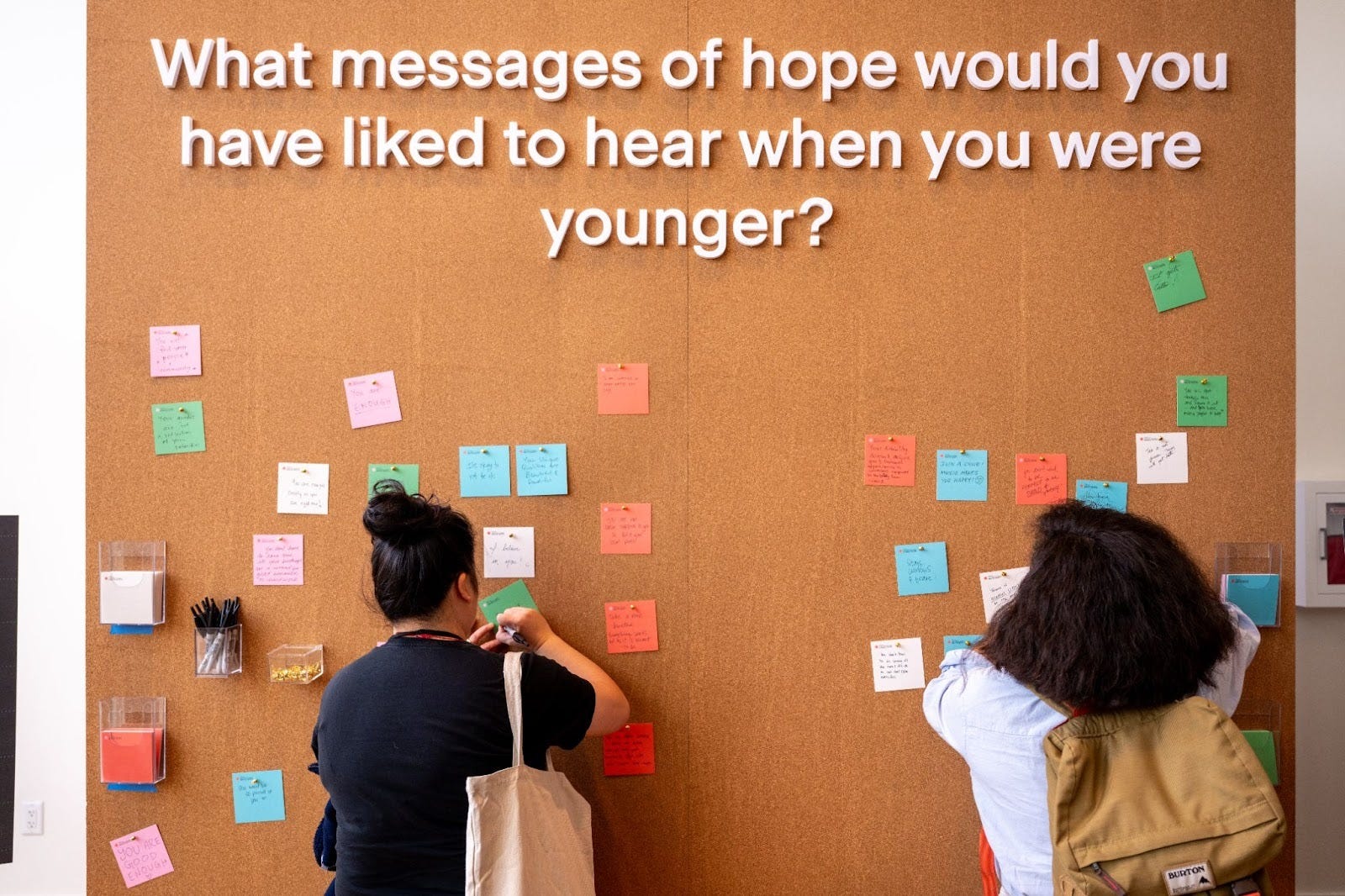
Attendees at TAAF’s AAPI Youth Mental Health Summit write notes of support. Photo courtesy of Ed Ritger / The Commonwealth Club World Affairs via The Asian American Foundation (TAAF).
Many in our community would have appreciated hearing these words during their childhoods. According to TAAF’s annual STAATUS Index, AAPI youth have the lowest sense of belonging among all major groups in the U.S. Along with tremendous pressures from themselves and their families, these feelings have taken a devastating toll on their mental health. Federal health data shows suicide is the leading cause of death for Asian American young adults between the ages of 18-25. It is a crisis that rarely makes the headlines, but one that demands our urgent attention.
As CEO of TAAF, I strongly believe that youth mental health is critical to our community’s future. Last year, we released Beyond the Surface, one of the most comprehensive national studies ever conducted on the issue with over 1,400 AAPI youth respondents across the country. What it shows is alarming:
48% of AAPI young people in our survey scored above the threshold for moderate to severe depression
30% of respondents report saying they have planned or attempted suicide
26% of those at risk have never seen a mental health provider.
When we asked AAPI youth what affects their mental health most, the top cited stressor is pressure from themselves and their families to succeed academically, competitively, or professionally. And many young people avoid speaking with their parents about mental health issues, saying they do not want to worry or burden them.
For many AAPIs, especially those from immigrant families, we are familiar with the pressures and expectations placed upon us, as well as the challenges of trying to bridge the cultural gap with our parents. As a second-generation, Chinese American growing up on the East Coast, I was very aware of being different from most of the other kids in my school. As a parent, I have also become keenly aware of the mental health challenges AAPI teenagers face today.
The decades ahead will be incalculably shaped by how we support our young people today. They are the next generation of leaders, innovators, and advocates, and we cannot fail them. That is why TAAF has invested in groundbreaking research and is now using our convening power to spark conversations around solutions.
Through our Youth Mental Health Summit came three key lessons:
First, we must confront reality, acknowledge our responsibility to reduce stigma around mental health, and look into breaking down some of our community’s most toxic expectations.
While digital platforms can often be filled with content that negatively impacts mental health, creatives like Midori Francis, Owin Pierson, and Ryan Alexander Holmes prove we can create spaces for healthy connections and honest discussions. Ultimately, it is on all of us to stem the cultural pressure, silence, and barriers that keep our young people from seeking out help, both online and offline.
Second, there are proven strategies to help reach AAPI youth where they are.
We heard from academics and experts from across the country who showcased parent-child conversation tools, peer support networks, boys’ and young men’s programs, expressive writing, and even culturally rooted activities like dragon boat racing. How we expand access to these activities and other mental health resources, as well as tackle the wider gap in funding and awareness around AAPI research, will ultimately make the difference for our children.
Finally, trusted voices like family members and friends are essential in starting much-needed conversations with young people.
Our Beyond the Surface study found 61% of AAPI youth feel they can turn to friends for support, and parents can also be a key resource. We should not underestimate the power to show up for the people in our lives, even if it means checking in or simply listening to someone in need.
AAPI youth do not have to face mental health struggles alone, and we each have a part to play to ensure they are supported as they navigate their identities. I left our summit confident that, together, we can build healing, let our youth know they are valued and belong, and build safety for generations to come.
Norman Chen is the chief executive officer of The Asian American Foundation. Prior to his appointment at TAAF, Chen co-founded the nonprofit Leading Asian Americans to Unite for Change (LAAUNCH) and helped to create a landmark study, the STAATUS Index, of American attitudes toward Asian Americans.