

Today’s stories open with a refugee’s son who made history on a Texas city council, followed by an immigrant tapped to lead a major university for the first time in 175 years. Then, we see justice in motion as a Colombian burglary ring that targeted Asian American homeowners and a pickpocket crew working San Francisco’s Chinatown both land in court. Meanwhile in South Korea, a nightclub sign and a coffee promotion each sparked a reckoning. We close the issue with a New Jersey fight over what communities are worth and a UN warning that could reshape dinner tables across the globe.
Featured
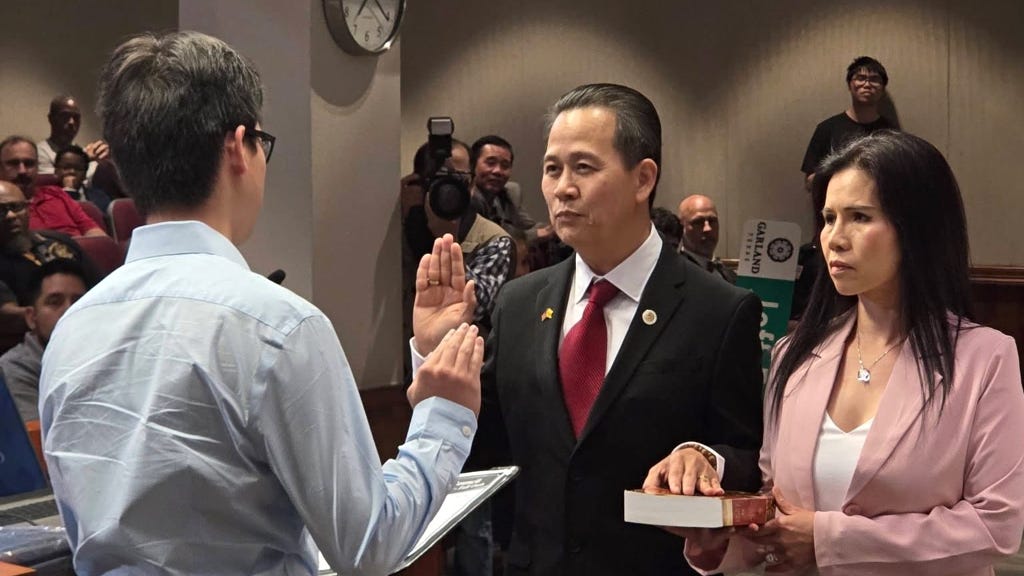
Texas city elects its 1st Viet American council member
Jimmy Tran arrived in the U.S. as a refugee in 1994 and assembled electronics on a minimum wage while studying English at night. This month, he was sworn in to represent District 1 in Garland, Texas.
His election makes him the first Vietnamese American and first Asian American on the council in an ever-growing Vietnamese community. But of course, his first priorities will show who he came to serve.
What else we’re tracking
Northwestern picks Chinese American as its next president
Mung Chiang moved from Tianjin to Hong Kong at 11, aced his exams and left for Stanford. Now, he is taking a job few Asian Americans hold anywhere, at a university that has never had an Asian American president in its history.
2 plead guilty in Colombian theft ring that targeted Asian Americans
Two more Colombian nationals pleaded guilty in a federal conspiracy that targeted Asian American business owners in Oregon and Washington state. The ring members, known as the “Skyline 7,” worked off one assumption about these homes. Interestingly, a quirk of Oregon law complicates how the case can be charged.
3 men charged in SF Chinatown pickpocket ring
Three men face felony charges after drones and undercover officers broke up a pickpocket ring in San Francisco’s Chinatown. A search turned up more than $14,000 and property tied to an earlier victim. Authorities called the crew “pros.”
‘No Filipinos allowed’ sign in South Korea sparks debate
A TikTok video describing South Korean venues that allegedly barred Filipinos and other Southeast Asians has drawn hundreds of thousands of views and a flood of similar accounts. The creator had seen exclusion before, but not like this. People are tracing it to something older than any one door.
Starbucks Korea ‘Tank Day’ promotion draws outrage
A Starbucks Korea promotion built around “Tank Day” launched on the anniversary of the 1980 Gwangju uprising, drawing accusations it mocked the pro-democracy movement. Protesters smashed tumblers, the CEO was gone within hours and even the president weighed in.
AAPI groups want $5 million from New Jersey budget
Asian American advocates packed the New Jersey Statehouse to ask the state for $5 million. Spread across that population, it comes to a few dollars per Asian American resident, after years with almost no direct state support. Lawmakers must decide whether even that is too much.
Hormuz conflict could soon lead to world food crisis, UN warns
The United Nations warns that trouble around the Strait of Hormuz could ripple all the way to dinner tables, impacting many parts of the world. The route from a shipping chokepoint to the price of a meal passes through fertilizer … and the window to act is closing fast.
Why read Issue #214?
This issue is about visibility and its cost. The same Asian American communities producing historic firsts are the ones whose homes get cased by burglars who assume the cash is inside. Across the Pacific, visibility cuts the other way, where being Filipino could be enough to be turned away at a door. Being seen is not the same as being safe, and safety rarely comes without a fight. We know that whether the threat is a thief, a budget line that overlooks you or a supply shock half a world away. This fight runs through courtrooms, statehouses and borders, and through the communities holding their ground in each.
Support independent Asian diaspora journalism. Become a paid subscriber to read the full stories and help sustain The Rebel Yellow.
The Rebel Yellow is supported in part by funding from The Asian American Foundation (TAAF). Funders do not influence story selection, reporting, or editorial decisions. All editorial content is independently produced by The Rebel Yellow team.